


How one American HVAC manufacturer demonstrates the productivity potential of a single autonomous mobile robot.
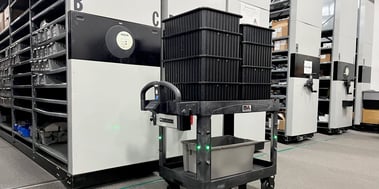
When a leading American manufacturer of commercial and industrial HVAC equipment deployed MARC, the objective was simple: reduce the time employees spend transporting materials between production areas.
Eighteen months later, the cart had completed 16,438 trips, averaging more than 900 trips per month.
That level of utilization reveals something important about manufacturing automation. Significant productivity gains do not always require complex systems or major infrastructure investments. Sometimes, automating a task repeated dozens of times each day is enough to make a measurable difference.
The manufacturer's MARC cart recorded the following activity:
| Performance Metric | Result |
|---|---|
| Time in service | 18 months |
| Total recorded trips | 16,438 |
| Average trips per month | 913 |
| Average trips per day | 30 |
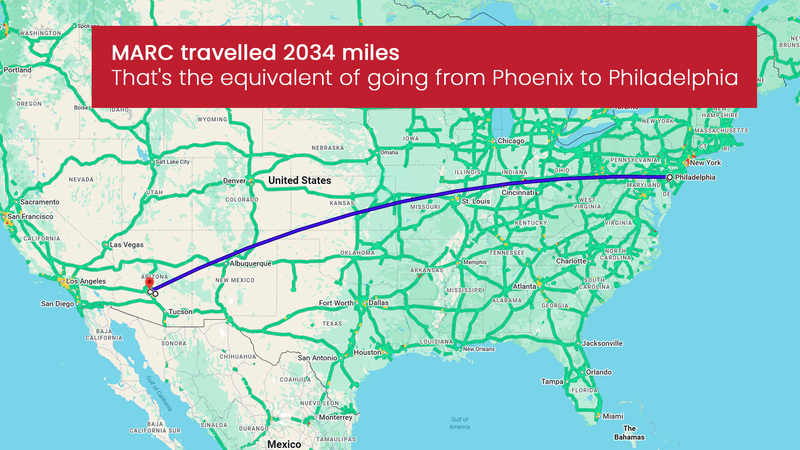
| Estimated distance traveled | 2,034 miles |
| Financial Metric |
Estimated Value |
|---|---|
| Potential employee hours recovered | 1,370 hours |
| Potential productivity value | $75,341 |
| MARC starting price | $9,999 |
| Modeled 18-month ROI | 653% |
| Estimated payback period | 2.4 months |
With an investment as low as $9999.00, the ROI can be measured in weeks, not years.
Rather than being restricted to one dedicated application, the cart is used for different material-handling tasks throughout the facility.
This flexibility is important. Manufacturing requirements change, production schedules shift, and material movements vary. An autonomous transport system that can support multiple workflows offers more opportunities to recover employee time from repetitive tasks.
Consider a scenario in which each autonomous trip eliminates five minutes of manual transportation.
Across 16,438 trips, that represents approximately 1,370 hours of potentially recovered employee time, equivalent to more than 34 standard 40-hour workweeks.
At an assumed fully burdened labor cost of $55 per hour, the financial opportunity becomes significant.
| Labor saved per trip | Potential productivity value | Modeled 18-month ROI |
|---|---|---|
| 3 minutes | $45,205 | 352% |
| 5 minutes | $75,341 |
653% |
| 10 minutes | $150,682 |
1,407% |
Under the five-minute scenario, a $9,999 investment generates a modeled 653% return on investment over 18 months, with an estimated payback period of approximately 2.4 months.
These figures are illustrative calculations based on assumptions for labor rates but uses recorded trips. The actual return depends on the amount of manual labor replaced, operating costs, and how effectively employees use the time recovered. But the point is that the return on your investment is much faster with MARC than most capital equipment.
Material transportation is essential to manufacturing, but it rarely adds direct value to the finished product.
An assembly technician may interrupt production to retrieve components. A machine operator may leave equipment unattended to deliver completed parts. These interruptions appear minor individually, but their cumulative effect can be substantial.
By assigning repetitive transport tasks to MARC, manufacturers can allow skilled employees to spend more time on assembly, machining, inspection, programming, and other value-add activities that they were hired for.
The result is not necessarily a reduction in headcount. The greater opportunity may be increasing productive capacity with the employees already available.
Recovered time can potentially support higher throughput, less overtime, and fewer workflow interruptions. However, those benefits must be measured rather than assumed.
Return on investment is influenced by more than the purchase price of an autonomous mobile robot.
Infrastructure modifications, systems integration, and installation requirements can substantially increase implementation costs.
MARC is designed to operate without facility Wi-Fi or installed navigation infrastructure, reducing deployment barriers in existing manufacturing environments.
For facilities with established production layouts, this creates an opportunity to automate material movement without undertaking a major facility modification project.
The cart's ability to support different transport applications also allows manufacturers to identify additional opportunities for automation as production needs evolve.
Learn how MūL Technologies helps manufacturers automate repetitive material movement without major infrastructure changes.